A Couple Thoughts on "Eaters" and a Review of "Nature's Metropolis" by William Cronon
Eating can indeed be a political act, but only if there is a producer whose values align with those of the eater. I fear that by identifying someone as an eater, a term with negative connotations based on the film The Menu and the TV series Silo, it continues to reproduce the concept of capitalism’s consumer. Many other people have reached the conclusion that it is the growing, sharing, and eating of food that is political. When I initially wrote the previous sentence, I used the words production, distribution, and consumption, which illustrates the insidious nature of capitalism, especially when living in a society that indoctrinates us from an early age.
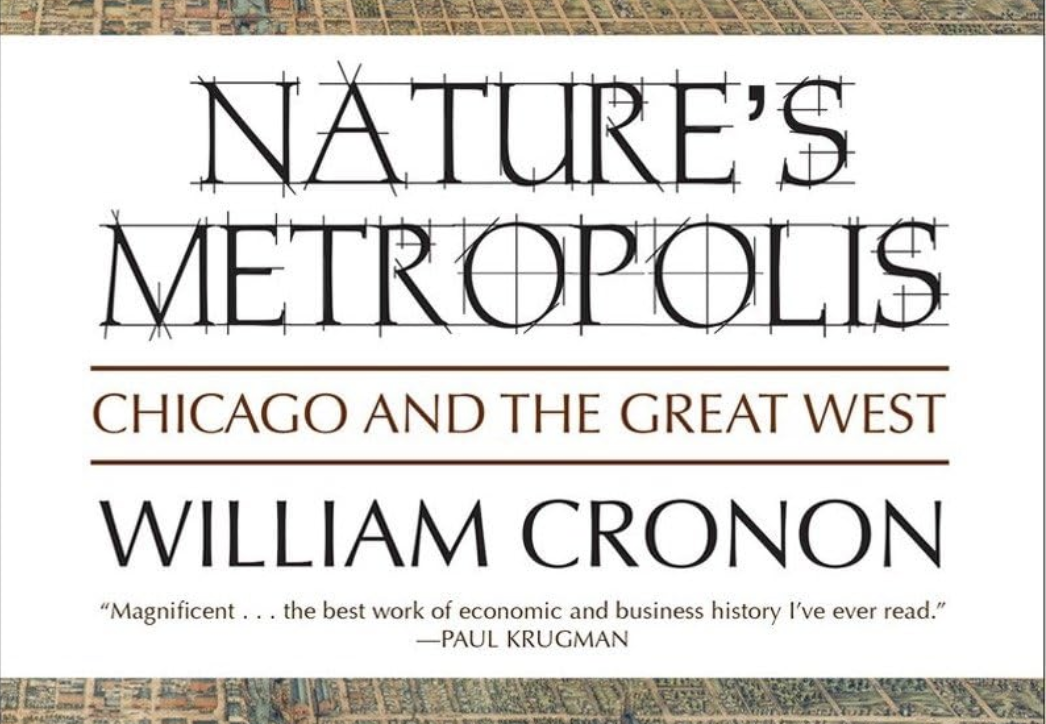
I bring this idea up because I recently wrote a review of Nature’s Metropolis by William Cronon, which explains the rise of Chicago during the mid-nineteenth century. Specifically, I think about his careful analysis regarding the co-evolution of language and capitalist ideology. It’s a dense work of economic history, but reading it in its entirety is worth the time.
Eating can indeed be a political act, but only if there is a producer whose values align with those of the eater. I fear that by identifying someone as an eater, a term with negative connotations based on the film The Menu and the TV series Silo, it continues to reproduce the concept of capitalism’s consumer. Many other people have reached the conclusion that it is the growing, sharing, and eating of food that is political. When I initially wrote the previous sentence, I used the words production, distribution, and consumption, which illustrates the insidious nature of capitalism, especially when living in a society that indoctrinates us from an early age.
I bring this idea up because I recently wrote a review of Nature’s Metropolis by William Cronon, which explains the rise of Chicago during the mid-nineteenth century. Specifically, I think about his careful analysis regarding the co-evolution of language and capitalist ideology. It’s a dense work of economic history, but reading it in its entirety is worth the time.
Language as a Function of Time, Space, and Ideology
Determinists are a dwindling breed amongst historians. New age scholars like William Cronon see historical moments as emergent systems resulting from complex interactions within a sea of dependent variables. In Nature’s Metropolis: Chicago and the Great West, Cronon pushes aside environmental determinists by showing that the seemingly natural advantages of mid-1800s Chicago were not unique nor always better than other mid-western cities. He describes this book as a work of economic history based on commodity flows, where the commodity market is the defining institution of the modern capitalist world affecting human and natural communities.2 The capital influx experienced by Chicago, in combination with certain environmental features and human engineering, turned the city into the most important metropolis defining the Midwest.3 In his analysis, Cronon takes some of his peers to task for falling into the trap of presentism by using a modern definition of the West and viewing Denver or San Francisco as the definitive western city. A deeper analysis reveals this book to be a treatise on ideology rather than a simple work of economic history. During Chicago’s rise, the functional abstraction of language and the needs of capital co-evolved and disconnected ordinary citizens from the origins of their commodities. Historians studying this time period often fall victim to ideology and presentism when they forget that language is a function of time and place.
Human beings, like all creatures, have specific needs from which language evolved. The Potawatomi called the future location of Chicago “Chigagou, ‘the wild garlic place.’”4 Language preserved the memory of this place as a source of seasonal sustenance, yet this function for human foragers was but one of countless functions in that complex ecosystem. The language of other species would prioritize different features. In this way, language is an abstraction that simplifies the landscape, inventing additional terms such as forest, grassland, and river that establish human-centric borders and succinctly communicate resource availability. These should not be viewed as natural boundaries because glaciers, geology, and various plant communities had established other divisions like “glaciated and un-glaciated, between well and poorly drained watersheds, [and] between fertile and less fertile soils.”5 Therefore, a careful study of language reveals human needs, wants, and future ambitions. Language and landscape shaped and molded each other because ecosystems that provided sustenance deserved a name, and that name would then define future land use practices. As cultures evolved, they demanded new words, which would further shape the landscape.
By the mid-1800s, Americans were entering a time of abundance rather than scarcity, and the capitalist ideology was sweeping the land, demanding a new linguistic function; assigning value. To generate capital, physical products derived from the land had to be commodified and adapted to new manufacturing processes and forms of transportation, especially railroads. However, Cronon reveals that this was not a wholly conscious process by analyzing changes in borders, grain, lumber, and meat. Gambling on the prospect of Chicago as the next great city, speculators began “buying and selling not only the empty lots along its ill-marked streets, but also the surrounding grasslands”6 in “in arbitrary units of sections, half sections, and 160-quarter acre sections.”7 Most importantly, speculators “dreamed of what the land might someday be, and gambled immense sums on their faith in a rising market.’”8 It was language, painting a picture in one’s mind, that gave land a value and new borders that fit within the confines of capitalism. Land now had an abstract value divorced from agricultural production, thus the physical products of that land had to be assigned a separate commodity value. Grain was originally sold in sacks traceable to the farmer who grew it,9 but it was not useful to the consumer until processed into flour. An abundant supply of flour allowed people to demand certain qualities, so they invented a language around desirable qualities such as purity and consistency. The capitalists were able to consolidate the grain supply and then convert it into the forms demanded by people, thus illustrating the co-evolution of language and capital.10 Similarly, harvested trees went from being purchased as timber for custom milling to a “humble two-by-four” because “customers who purchased the bulk of Chicago’s lumber sought it in regular dimensions.”11 Capitalists did not invent standardized sizing, but were willing to respond to the language built around a standardized architecture. In each case, the original resource was obscured by the new language.
While meat followed a similar path of standardization, it was unique in that capitalists drove the change in language. Meat was originally produced by butchers whom would buy an animal and then slaughter them onsite for direct sale to consumers. To concentrate the processing and distribution, capitalists invented refrigerated train cars in order to butcher animals in large processing plants, then ship it in standardized packages to consumers in Chicago and beyond. They then dropped prices and offered samples to distrusting consumers until people showed “great enthusiasm for the product.”12 Capitalists also had many leftover animal parts, which they turned “into dozens and then hundreds of commodities,’”13 such as bouillon. Language and capitalism evolved by solving problems created by each new innovation. The invention of a new market revealed capitalism’s ability to both react to, and create, new language, thus supporting the largely unintentional commodification claim made by Cronon.
When physical limits were reached, or the markets became saturated, new language created another layer of abstraction so that the very idea of nature and Chicago could be capitalized upon. “Because one could reach Lake Geneva from Chicago in less than three hours, it quickly developed the population cycles on associate with Wisconsin resort areas to this day. Dense populations of well-to-do tourists spent large amounts of money there during the summer.”14 As the urban landscape expanded, pollution continued to accumulate, and disposable income increased, city residents expressed a desire to return to nature and they had money to burn. Capitalists were happy to oblige with train rides, restaurants, and quaint cottages. And for rural resident’s, Chicago’s World’s Fair welcomed them to tour the city and experience the metropolis at the heart of “the greatest era of civilized progress the world had ever seen.”15 These residents of the hinterlands were reminded at the fair that their success depended upon the success of Chicago, thus they were being sold a vision of the future.
Clearly, language has the capacity to reveal as much as it obscures, a risk magnified within the historical profession because definitions change based on time and space. Dispelling the myth that the the West began anywhere other than Chicago in the mid-1800s, Cronon cautions against presentism because trying “to redefine the West to fit our modern vocabulary is to do violence to the way Americans in the past understood that term, since for them it was intimately tied to that other, now problematic word—‘frontier.’”16 Historians can divorce themselves from the past just as readily as Chicagoans could divorce their flour from the farm through language. A different idea of the West would make the capital influx invisible or misattributed to a cause other than being the link between New York and the frontier. Further challenging historians is a lack of precise language. Cronon illustrates this problem by asking “at what moment, exactly, did the city of Chicago cease to be part of nature?”17 He is uncomfortable with the word nature due to its ambiguity, calling it “an abstraction in my daily life—a non-urban quality of aesthetic or sacred beauty to be looked at and ‘appreciate.’”18 If language is not precise, then it opens up the possibility of misinterpretations between audience and author. For example, the term nature also created false dichotomies: natural versus unnatural, urban versus rural. These dichotomies obscure the fact that the city and countryside influenced each other in such a way that the nature city dwellers sought had been transformed to a degree where it was unrecognizable to the Potawatomi. Chicago’s demand for raw materials transformed grasslands into farms and mature forests into grasslands. Cronon’s use of the term hinterlands tries to elicit this ongoing connection between Chicago and its surrounding lands. Historians, therefore, have multiple traps they must avoid because old terms gain new meanings.
By the turn of the century, urban Chicago would not be confused with Chigagou. New demands made by Chicago residents and capitalists produced new language to describe what they sought from the landscape. When abundance devalued physical commodities, capitalists figured out how to monetize a mythologized past and future. A new layer of abstraction had arrived, increasing the difficulty for historians looking back at mid-nineteenth century Chicago in search of the material foundation of that modernizing society. While telling this story, Cronon prompts current and future historians to give proper attention to language by verifying that modern definitions of terms such as the West match their historical usage. Not only that, language can obscure, as much as reveal, truths. With beautiful prose, Cronon reminds his audience that the abstraction of language obscures a simple, yet profound truth: all existence rests on the ability of the Earth to turn sunlight into useable forms of energy.